
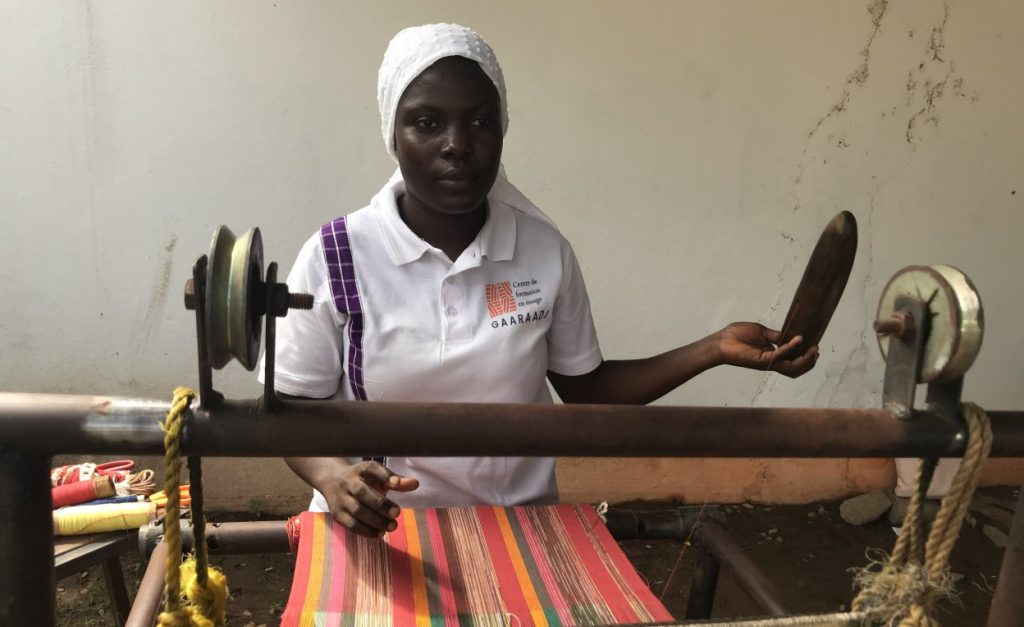
A new training centre in Garoua is teaching young women to turn locally grown cotton thread into finished fabric. Still operating on a modest scale, Gaaraadji is creating incomes, developing scarce textile skills and showing how Cameroon could process more of one of its most important crops at home.
Twenty-year-old Solantine Maifrigi counts the threads one by one. She lifts her feet in a steady rhythm, passes a wooden shuttle from hand to hand and concentrates on preventing the threads from breaking as she weaves a 30-metre length of cotton fabric.
After the grandmother she had been caring for died, Maifrigi returned to her parents without a business or an income. She initially hoped to become a seamstress and paid FCFA 5,000 (US$8.90) a month for training. But when her younger sister, whom she had encouraged to learn a craft, became interested in weaving, Maifrigi decided to try it too.
Before joining the Gaaraadji Training Centre in Garoua’s Poumpoumré neighbourhood in northern Cameroon, she had never encountered textile weaving.
“During my free one-year training at the centre, I learned how to weave, dye and embroider clothing. I was asked to stay after completing the course,” she says.
Her monthly stipend helps cover food, clothing and rent.
“Thanks to my employment at the centre, I was able to buy a sewing machine,” she says, adding that she now sees new opportunities in the textile industry.
Like Maifrigi, 18-year-old single mother Nafisatou previously survived by selling a small range of goods. Since joining the centre, she has learned to weave and can better support herself and her child.
The two are among 10 young people retained from an initial group of 20 trainees. They learned to work with gaaraadji the Fulfulde word for thread made from cotton grown in Cameroon’s northern regions.
Cameroon produces about 350,000 tonnes of seed cotton annually under the supervision of the Cotton Development Company, SODECOTON, making it Africa’s fifth-largest producer. Yet little of the crop is processed locally.
According to Business in Cameroon, only about 5% of the country’s cotton is processed domestically. Around 3,000 tonnes a year were previously processed in Garoua by the Cotton Industrial Company of Cameroon, CICAM, whose operations in the city were suspended.
While West African producers such as Burkina Faso and Benin are pursuing domestic-processing strategies, Cameroon is only beginning to develop this part of its value chain.
The absence of CICAM’s operations in Garoua, together with delays in fully establishing the proposed CAMTEX industrial platform, has created room for smaller initiatives such as Gaaraadji.
Operating from premises covering more than 700 square metres, the centre has installed machinery to turn locally sourced thread into handmade cotton textiles.
“We source Cameroonian thread produced by SODECOTON through CICAM, as well as from other suppliers, depending on demand,” says Sonia Hayatou, founder of the Gaaraadji Training Centre.
Hayatou, a chemist with a passion for sewing, returned to Cameroon after working in Europe for 17 years. She hopes that, within five years, Gaaraadji will become one of the businesses processing more of the country’s cotton locally.
For now, the centre uses just over 100kg of cotton thread a month but hopes to increase production.
“We produce fabric every two days. Demand is high, especially for weddings,” Hayatou says. “We bring something new by personalising designs and ensuring quality, so customers no longer have to travel to West Africa in search of fabric. They also have the advantage of being able to monitor production.”
She believes Gaaraadji could eventually respond to larger orders, including those for uniforms.
Although its output remains modest, the centre is gaining recognition. It was selected from among 600 enterprises participating in the 2026 Cameroon International Handicrafts Fair, SIARC , organised by the Ministry of Small and Medium-sized Enterprises, Social Economy and Handicrafts, MINPMEESA, to showcase the country’s crafts.
“We recently produced a collection of 12 outfits made from 100% cotton, woven in Garoua and sewn in Yaoundé, in less than a month for the Environment, Ecosystem, Fashion and Design Forum organised by MINPMEESA,” Hayatou recalls.
Adama Habiya, MINPMEESA’s representative at Garoua II Council, says Gaaraadji was selected because of the originality and cultural significance of its work, its use of locally produced cotton and the jobs it is creating.
Since registering as a craft business with the council, Gaaraadji has also received technical and financial support through MINPMEESA’s decentralised services.
“What we appreciate about this centre is its dedication, the founder’s passion for the craft and the quality of its finished products,” Habiya says. “We encourage the centre to persevere, innovate, establish itself in national and international markets, and adapt to the changing landscape, including ICT, standards and quality requirements, intellectual property protection and business formalisation.”
When Cameroon hosted the World Trade Organization’s 14th Ministerial Conference in Yaoundé from 26 to 29 March 2026, including a side event for cotton-producing countries, Gaaraadji was invited to demonstrate its work.
“We demonstrated the journey from cotton to thread using a spinning wheel, and then from weaving to finished fabric,” Hayatou says.
Ousmanou Garba, director of the Garoua Crafts Village, says the initiative comes at a time when Cameroon needs improved weaving techniques to advance its National Development Strategy 2020–2030 and import-substitution policy, which promotes Made in Cameroon products.
The Garoua Regional Crafts Village provides Gaaraadji with technical guidance, expertise and practical advice, while also including it in trade fairs and exhibitions.
“We firmly believe that this centre will contribute to women’s empowerment through weaving, something we are already witnessing first-hand,” Garba says. “Its woven products are of high quality and meet a variety of needs within the region and beyond.”
In October 2026, Gaaraadji plans to begin offering formal vocational courses after receiving authorisation from the Ministry of Employment and Vocational Training. It will continue providing weaving instruction to women from disadvantaged backgrounds.
One challenge is promoting weaving in ways that resonate with Cameroonians and persuading consumers to see locally made cotton clothing as an investment, particularly in a market where many people rely on cheaper second-hand clothes.
Hayatou argues that the cost need not be prohibitive. The centre’s fabrics range from FCFA 2,500 (US$4.45) to about FCFA 40,000 (US$71).
She dreams of Cameroon following countries such as Burkina Faso and Mali in embracing domestic cotton processing as a way to strengthen the economy.
“Although we are still at an early stage, we are part of this movement,” she says.
SOURCE: By Leocadia Bongben/AllAfrica