
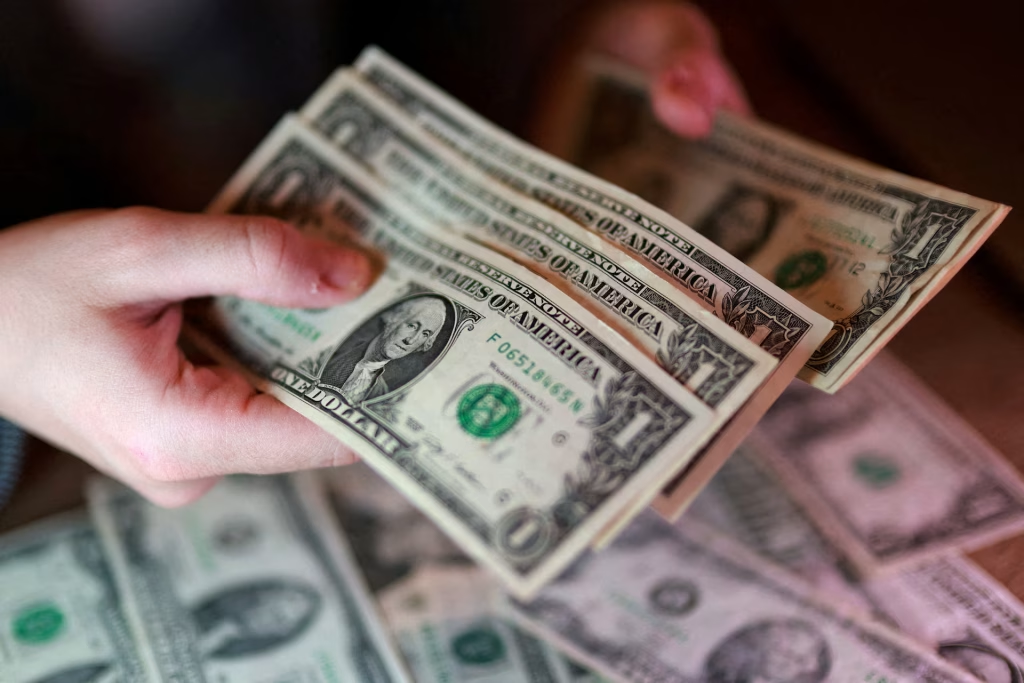
The dollar dropped sharply against major peers on Thursday after President Donald Trump called off plans for renewed U.S. military strikes on Iran at the last minute, saying negotiations with Tehran were heading towards a possible deal.
The dollar tends to strengthen during periods of heightened geopolitical uncertainty, as investors seek safe-haven U.S. Treasury bonds, while it typically weakens when expectations of peace rise and money flows into riskier investments.
Trump said negotiations with Tehran had advanced to the highest levels of Iran’s leadership and a deal had been approved by a broad coalition of regional powers.
Iran’s semi-official Fars news agency reported that Tehran is likely to approve the agreement, although it has yet to give a formal response.
The dollar weakened 0.68% to 0.7948 against the Swiss franc , relinquishing its early gains and on track to snap four straight sessions of rises.
Earlier in the day, Trump had said that the U.S. would hit Iran “very hard tonight” and that he wanted at some point to take Iran’s oil infrastructure hub , after a second day of strikes by both sides in the Gulf appeared to threaten a return to all-out war.
“I think we’re getting accustomed to this pattern of escalation so that there can be a de-escalation, which is reflected in the foreign exchange market,” said Juan Perez, director of trading at Monex USA.
“Anytime there’s a likelihood of continuation of prolonged aggression and violence and war, that’s going to be very dollar positive. At the same time, when we have this idea floating around that we could have a sudden stop of aggression in a peace agreement, it makes sense for equities to rise up. Appetite for riskier assets is naturally going to kill the dollar.”
The euro rose 0.42% to $1.15820, reversing losses in tepid trading earlier in the session after the European Central Bank raised interest rates for the first time in nearly three years, aiming to curb energy-induced inflation caused by the Iran war.
The dollar index , which measures the greenback against a basket of currencies including the yen and the euro, fell 0.41% to 99.64, dropping to a near one-week low.
“Yet again during another U.S. session, President Trump has said something that called off the bombing that he threatened Iran with and he says something that ‘peace is at hand’, and the market does what it does on these kinds of things: they take on more risk,” said Marc Chandler, chief market strategist at Bannockburn Global Forex.
“That means buying stocks, buying equities, buying risk assets. But one of the things it also means is selling the dollar.”
All three indexes on Wall Street added to gains and finished higher on the day following Trump’s comments, with the Nasdaq jumping 2.5%.
Meanwhile, U.S. Treasury yields fell across the board. The yield on benchmark U.S. 10-year notes fell 8.7 basis points to 4.453%.
CENTRAL BANK MOVES
The Federal Reserve is expected to hold rates steady next week at Kevin Warsh’s first meeting as Fed chair, with a strong majority of economists in a Reuters poll predicting that the U.S. central bank would keep rates unchanged for the rest of 2026.
Traders, however, have fully priced in a 25-basis-point hike by December, a sharp turn from expectations of two rate cuts this year before the Iran war erupted at the end of February.
The Bank of Japan also meets next week and is expected to hike rates, although Governor Kazuo Ueda has been hospitalised for medical treatment and will miss the June 15 to 16 policy meeting.
The Japanese yen rose 0.49% against the greenback to 159.73 per dollar, still hovering near levels that could trigger official intervention from Tokyo.
Sterling strengthened 0.37% against the dollar to $1.3415, reversing earlier losses. The Australian dollar strengthened 0.66% versus the greenback to $0.7048.
SOURCE: Reporting by Chibuike Oguh in New York; Editing by Alex Richardson, Andrea Ricci and Edmund Klamann / Reuters