
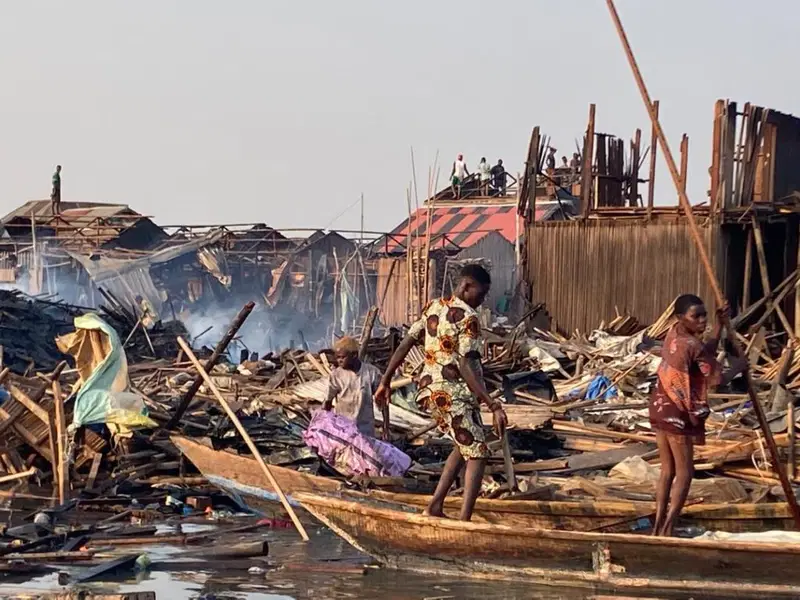
Makoko Demolitions Leave Thousands Displaced in Africa’s Largest Floating Slum
Hundreds of wooden homes have been flattened in Makoko, Africa’s largest floating slum, after amphibious excavators escorted by armed police moved into the waterfront community in Lagos, displacing tens of thousands of residents and reigniting debate over forced evictions in Nigeria’s commercial capital.
The demolitions, which began days before Christmas, targeted stilted structures built over the lagoon. Authorities say the operation is part of a safety and urban renewal drive, while residents and rights groups accuse the government of clearing the area to reclaim waterfront land for real-estate development.
At least three people, including two babies, have died from the effects of teargas fired during the operation, according to three rights groups. An NGO estimates that more than 30,000 residents have been displaced, many of them without prior notice, a claim the Lagos State Government disputes.
“They treated us like we are less than animals,” said Alex Wusa, a 25-year-old teacher whose home, shop, and school were demolished. Families have since been forced to sleep in canoes or makeshift shelters, with heavy rains worsening conditions. “This suffering is too much,” said Iyabo Olaleye, a fishmonger who lost two houses.
Makoko, which has existed for over a century, is home to low-income earners largely dependent on fishing and informal trade. Population estimates range from 80,000 to over 300,000, reflecting the absence of official data. The community’s homes on stilts over Lagos’s polluted lagoon have long symbolised both urban poverty and resilience, and have repeatedly been at the centre of land disputes.
Lagos officials argue the demolitions were necessary because structures were built within 100 metres of high-tension transmission lines crossing the lagoon. Urban renewal authorities say residents were warned in advance. However, a coalition of five NGOs claims homes beyond the stated safety perimeter were destroyed and alleges collusion between government actors and private developers amid ongoing land reclamation nearby.
The episode has renewed scrutiny of Lagos’s housing crisis. Despite severe shortages and widespread homelessness, thousands of homes in affluent neighbourhoods remain vacant due to soaring rents. Experts say roughly half of Lagos’s population lives in slums, with even makeshift shelters commanding high rents.
Urban planners and civil society groups are calling for alternatives to forced evictions, including in-situ upgrading of informal settlements like Makoko. “Gentrification that improves living conditions without displacement is possible,” said Timothy Nubi, a professor at the University of Lagos, warning that repeated clearances only deepen inequality in a rapidly growing megacity.
Culled from: Guardian Ng