
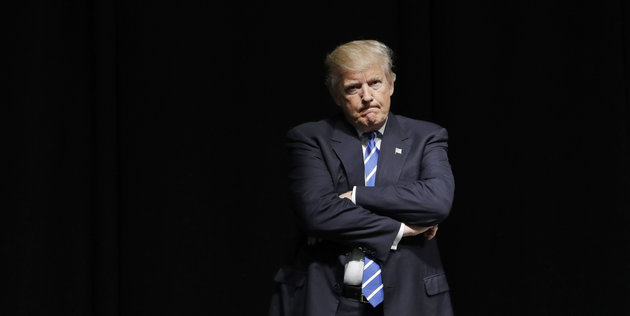
Nigeria has reacted strongly to recent comments by former U.S. President Donald Trump, who threatened possible military strikes on Nigeria over alleged killings of Christians. The Nigerian government has described the remarks as “unwarranted, misleading, and potentially destabilizing.”
The controversy began over the weekend after Trump posted on his social media platform, Truth Social, accusing Nigeria’s government of “allowing the slaughter of Christians.” He claimed that the United States “would not stand by” and ordered the Pentagon to prepare for “possible action,” promising that any U.S. strike would be “fast, vicious, and sweet.”
The remarks followed the U.S. State Department’s decision to include Nigeria once again on its list of “Countries of Particular Concern” (CPC) for alleged religious freedom violations. The announcement reportedly came after weeks of lobbying from evangelical groups and conservative lawmakers in the United States who have long accused Nigeria of failing to protect its Christian population.
However, security experts and rights observers note that violence in Nigeria affects both Christians and Muslims, particularly in the northern and central regions where clashes between herders and farmers are often rooted in resource scarcity and banditry rather than religious ideology.
“The situation in Nigeria is complex — a mix of political, economic, and environmental crises,” said a senior security analyst in Abuja. “Simplifying it as religious persecution misses the real issues.”
No U.S. Military Orders Yet
According to a Reuters report, the Pentagon has not issued any operational orders related to Nigeria, despite Trump’s online directive. U.S. defense officials said there were “no specific plans” for troop deployment or air strikes, though internal discussions were ongoing to assess the implications of Trump’s statement.
The White House, through spokesperson Anna Kelly, defended the former president’s remarks, saying Trump was motivated to “take action against the existential threat that Christians are facing in Nigeria.”
Evangelical leader Gary Bauer, who reportedly lobbied the Trump campaign, told Reuters that “people increasingly worried about attacks on Christians pushed the president to act.”
Nigeria’s Response
In Abuja, the Nigerian government moved swiftly to calm tensions and reaffirm national sovereignty. Presidential spokesperson Daniel Bwala stated that Nigeria rejects any form of foreign interference in its internal security affairs and warned against narratives that could inflame religious divisions.
“Our government remains committed to protecting all Nigerians, regardless of faith,” Bwala said. “The framing of our security challenges as religious persecution is inaccurate and dangerous.”
The Minister of Foreign Affairs also confirmed that diplomatic channels have been opened with Washington to clarify the situation and ensure that bilateral relations remain stable.
Meanwhile, President Bola Tinubu has directed the newly appointed service chiefs to intensify operations against insurgents, bandits, and violent extremists across the country. The directive followed reports that the U.S. threat came amid a broader military shake-up within Nigeria’s armed forces.
Background to the Violence
Nigeria has endured more than a decade of violence from insurgent groups such as Boko Haram and Islamic State West Africa Province (ISWAP), whose attacks have killed tens of thousands and displaced millions, mostly in the North-East.
Beyond terrorism, deadly clashes between farmers and herders in the North-Central region and widespread kidnapping for ransom in the North-West continue to destabilize communities. Analysts argue that while some victims are Christians, most casualties are Muslims, reflecting the widespread reach of insecurity rather than targeted religious violence.
A Diplomatic Test
Trump’s comments have drawn global attention to Nigeria’s long-standing security crisis and raised fears of renewed Western pressure. Analysts warn that labeling the crisis as a “Christian genocide” could worsen sectarian tensions in Africa’s most populous nation.
A former U.S. envoy to the region, J. Peter Pham, told Reuters that while Christians have suffered disproportionately in some attacks, “the vast majority of victims of Islamist violence are still Muslims.”
For Nigeria, the challenge now is to defend its sovereignty while addressing legitimate human rights concerns. The government says its focus remains on uniting the country and combating insecurity through stronger intelligence and inter-agency coordination.
“Nigeria does not need threats; it needs partnership,” a senior government official told Above Whispers. “We will continue to work with our allies, but on the basis of mutual respect.”