
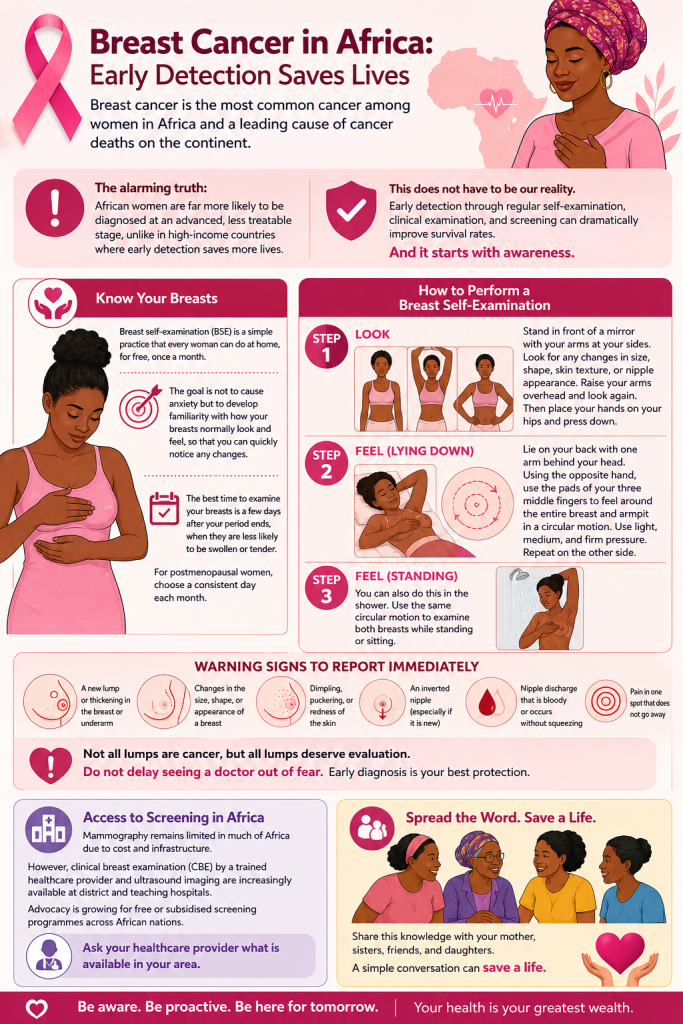
Early detection saves lives, and it starts with your own hands.
Introduction
Breast cancer is the most common cancer among women in Africa and one of the leading causes of cancer deaths on the continent. What makes the situation particularly alarming is not just the incidence, but the stage at which it is typically diagnosed. While women in high-income countries are increasingly surviving breast cancer due to early detection, African women are far more likely to receive a diagnosis at an advanced, less treatable stage.
This does not have to be our reality. Early detection through regular self-examination, clinical examination, and screening can dramatically improve survival rates. And it starts with awareness.
Know Your Breasts
Breast self-examination (BSE) is a simple practice that every woman can do at home, for free, once a month. The goal is not to cause anxiety but to develop familiarity with how your breasts normally look and feel, so that you can quickly notice any changes.
The best time to examine your breasts is a few days after your period ends, when they are less likely to be swollen or tender. For postmenopausal women, choose a consistent day each month.
How to Perform a Breast Self-Examination
Step 1 — Look: Stand in front of a mirror with your arms at your sides. Look for any changes in size, shape, skin texture, or nipple appearance. Raise your arms overhead and look again. Then place your hands on your hips and press down.
Step 2 — Feel (lying down): Lie on your back with one arm behind your head. Using the opposite hand, use the pads of your three middle fingers to feel around the entire breast and armpit in a circular motion. Use light, medium, and firm pressure. Repeat on the other side.
Step 3 — Feel (standing): You can also do this in the shower. Use the same circular motion to examine both breasts while standing or sitting.
Warning Signs to Report Immediately
• A new lump or thickening in the breast or underarm
• Changes in the size, shape, or appearance of a breast
• Dimpling, puckering, or redness of the skin
• An inverted nipple (especially if it is new)
• Nipple discharge that is bloody or occurs without squeezing
• Pain in one spot that does not go away
Not all lumps are cancer, but all lumps deserve evaluation. Do not delay seeing a doctor out of fear. Early diagnosis is your best protection.
Access to Screening in Africa
Mammography remains limited in much of Africa due to cost and infrastructure. However, clinical breast examination (CBE) by a trained healthcare provider and ultrasound imaging are increasingly available at district and teaching hospitals. Advocacy is growing for free or subsidised screening programmes across African nations. Ask your healthcare provider what is available in your area.
Share this knowledge with your mother, sisters, friends, and daughters. A simple conversation can save a life.