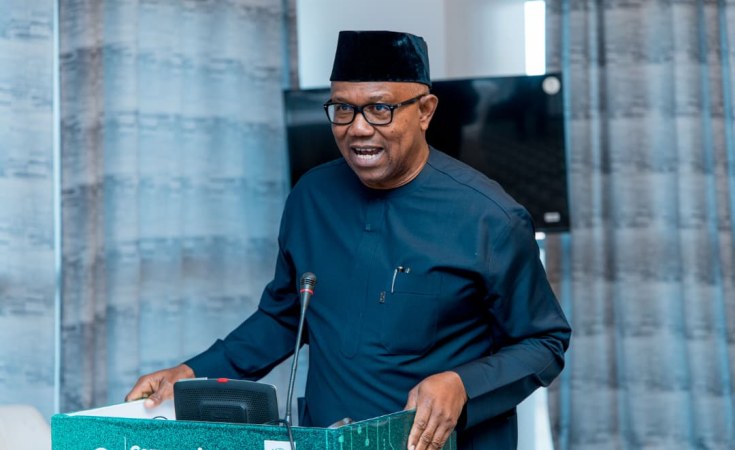
Nigeria’s opposition landscape witnessed a fresh shake-up on Sunday as former Anambra State governor, Peter Obi, and former Kano State governor, Senator Rabiu Musa Kwankwaso, formally exited the African Democratic Congress (ADC) to join the National Democratic Coalition (NDC), intensifying permutations ahead of the 2027 general elections.
Obi and Kwankwaso were seen receiving membership cards from the NDC leader in a video circulating online yesterday.
In the video, Kwankwaso was first presented with his membership card, followed by Obi’s, suggesting their formal entry into the party.
Just hours earlier, both politicians held a closed-door meeting with leaders of the NDC at the Abuja residence of the party’s National Leader and former Bayelsa State Governor, Seriake Dickson.
Meanwhile, Peter Obi has urged members of his new party to shun litigation and internal disputes, warning that court battles could undermine efforts to build a viable political alternative ahead of the 2027 general elections.
Obi made the appeal in remarks captured in a video circulating on Sunday, shortly after he and Kwankwaso reeived party membership cards.
Addressing party members, Obi stressed the need for unity and discipline, noting that internal legal conflicts had historically weakened political parties in Nigeria.
“Please let there be no litigation. Party members, please don’t go to court. We want to build a party; we are not lawyers,” he said.
The twin defections, coming amid ongoing efforts to forge a united opposition front, have triggered sharp reactions from the Presidency, the ruling All Progressives Congress (APC), and key stakeholders within the ADC.
Obi, who announced his resignation in a statement posted on X, blamed what he described as a “toxic” internal environment within the ADC, linking it to broader dysfunction in Nigeria’s political system.
“We now live in an environment that has become increasingly toxic, where the very system that should protect and create opportunities for decent living often works against the people…,” he said.
He, however, dismissed speculation of personal grievances, maintaining that his decision was not directed at party leaders, including Senator David Mark and former Vice President Atiku Abubakar.
Kwankwaso’s camp also confirmed a coordinated exit, citing internal challenges and the urgency of political realignments ahead of 2027.
His spokesperson, Saleh Muhammad, said the decision followed consultations across grassroots stakeholders.
“It was unanimously agreed that we should move out of the ADC,” he said.
Presidency, APC Fire Back
The Presidency responded with scathing criticism, describing Obi as a “political nomad.”
Special Adviser to the President on Information and Strategy, Bayo Onanuga, in a post on X, dismissed Obi’s justification as “illogical musings” and accused him of avoiding political contestation.
“He pursues the easy road; that will only lead him to doom, like in 2023,” Onanuga said, adding, “Welcome, Peter to the 2027 race.”
Similarly, the APC derided Obi as a “rolling stone,” accusing him of serial defections in search of an uncontested presidential ticket.
ADC Stakeholders Express Concern
Within the ADC, the defections have sparked concern over the stability of the opposition coalition project.
A chieftain of the party, Salihu Lukman, in an open letter to Kwankwaso, warned that repeated political shifts could diminish his stature and portray him as driven by personal ambition.
Titled “You can’t run away from yourself,” the letter stressed that opposition unity remains critical to defeating the APC in 2027.
Lukman argued that fragmentation cost the opposition victory in 2023 and cautioned against abandoning ongoing coalition efforts.
“Unity of all opposition leaders under one platform is a critical success factor for electoral victory,” he stated.
He also revealed that consultations among key opposition figures–including Obi and Atiku Abubakar–had been ongoing since 2024 to build a common front.
NDC Welcomes New Entrants
Welcoming the defectors, NDC founder and national leader, Senator Seriake Dickson, described the party as a fast-growing platform ready to challenge the status quo.
“NDC… is prepared to box above its weight… a party that has no faction, no litigation whatsoever,” he said.
Warnings Over Further Defections
Meanwhile, the Grassroots Mobilisation Network (GMN), an ADC support group, warned that continued defections could weaken opposition credibility and fuel suspicions of covert alignment with the ruling party.
National Secretary of the group, Usman Bala Idris, cautioned against abandoning party structures at a critical political moment.
“Moving from one party to another will not solve the problem… The appropriate response is to stay and rebuild,” he said.
CISLAC Warns Against Ideology-Free Defections by Obi, Kwankwaso
The Civil Society Legislative Advocacy Centre (CISLAC) has raised concerns over the defection of former Anambra State governor, Peter Obi, and former Kano State governor, Senator Rabiu Musa Kwankwaso, from the African Democratic Congress (ADC) to the National Democratic Coalition (NDC), warning that Nigeria’s democracy risks further erosion without ideology-driven politics.
In a statement issued in Abuja, Executive Director of CISLAC and Head of Transparency International Nigeria, Auwal Ibrahim Musa-Rafsanjani, said while political realignments are a legitimate feature of democracy, they must be anchored on clear ideological direction and the public interest–not political expediency.
CISLAC noted that frequent defections by political actors in Nigeria often lack policy substance, weakening party structures and eroding public trust in democratic institutions.
“Political parties should represent coherent visions for national development, and any movement across party lines should be anchored on well-articulated programmes that address Nigeria’s pressing challenges, including economic hardship, insecurity, corruption and social inequality,” the statement read.
While acknowledging the constitutional right to freedom of association, the organisation urged Obi and Kwankwaso to clearly explain the rationale behind their move and demonstrate how their new political alignment would better serve Nigerians.
“Nigerians deserve clarity, consistency and accountability from those seeking to lead,” CISLAC stated.
The group also called on political parties to strengthen internal democracy, ensure transparency in candidate selection processes, and avoid actions capable of deepening political fragmentation or voter apathy ahead of future elections.
It warned that the persistent trend of elite-driven defections without meaningful engagement with citizens risks further alienating the electorate.
CISLAC further urged the Independent National Electoral Commission (INEC) to remain vigilant in ensuring that all processes related to such defections comply with constitutional provisions and electoral guidelines.
According to the organisation, strict adherence to these regulations is essential to safeguarding the integrity of Nigeria’s democratic system.
The group reiterated that democracy can only thrive when political actors prioritise national interest above personal ambition and remain accountable to the people.
SOURCE: Leadership/AllAfrica