
By Naomi Jeremiah
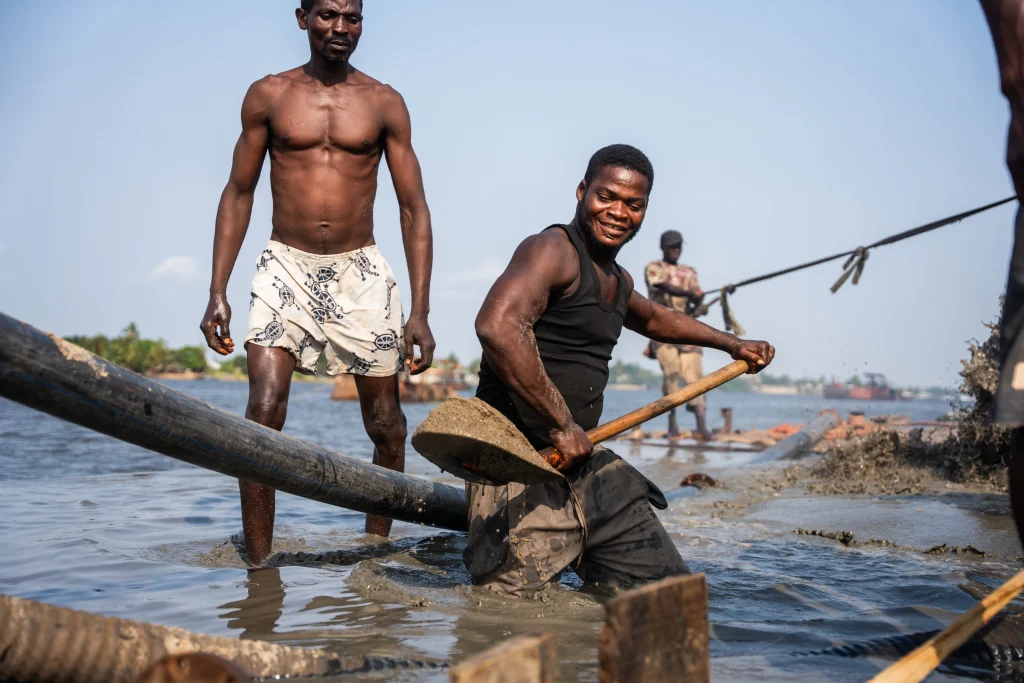
Every three hours, a wooden boat filled with lagoon sand leaves the waters beneath one of Lagos’ busiest expressways. The load earns about ₦12,000 ($8) for the men who dive beneath the surface 15 seconds at a time to scoop sediment from the lagoon floor.
That sand, once part of Lagos’ natural buffer, now fuels a construction industry where a single 30-ton truckload sells for as much as ₦290,000. As demand surges, the lagoon that sustains millions is being steadily carved apart.
Lagos, home to an estimated 17 million people, is expanding rapidly through land reclamation, road construction and waterfront developments. To keep pace, tens of millions of cubic meters of sand are extracted each year much of it from the lagoon itself.
For dredgers like 34-year-old Akeem Sossu, the work is survival. Formerly a tailor, he now spends his mornings diving into murky water, filling buckets that are hauled onto boats headed for construction sites.
“This is what feeds my family now,” he said.
But as the sand trade grows, fishing communities say the cost is becoming unbearable.
Around Makoko, one of Lagos’ oldest waterfront settlements, channels that once supported fishing have narrowed, currents have shifted, and shallow breeding grounds have vanished. Residents say fish stocks have collapsed, pushing fishermen farther offshore or out of work entirely.
“Where dredging happens, fish disappear,” said Makoko community leader Baale Semede Emmanuel. “Their homes are gone.”
Some fishermen say they now wait for dredging to pause before casting their nets, hoping fish will briefly return. Others have abandoned the water altogether. Rising fuel costs sometimes exceeding ₦150,000 per trip make longer journeys risky, with no guarantee of a catch.
While fishermen struggle, dredging offers rare income in a city with limited opportunities. Informal operators say payments to authorities allow operations to continue, even in areas officially marked as restricted.
Environmental researchers warn the consequences go beyond lost livelihoods. Studies conducted in major dredging zones show elevated water turbidity, unstable seabeds and conditions that disrupt fish feeding and reproduction. Wetlands that once absorbed floodwaters are being degraded, increasing long-term flood risks in a city already vulnerable to rising seas and extreme rainfall.
State authorities have pledged to crack down on illegal dredging and protect waterfront communities. But residents say enforcement is uneven, allowing extraction to resume soon after interventions.
As sand prices climb and Lagos continues to build outward, the lagoon is paying the price, its waters reshaped not by tides, but by the economics of a city rising on what it removes.
Source: The Associated Press (AP)